Restaurant temperature compliance in Australia is not optional. It is a legal requirement enforced by local food safety authorities, and repeated breaches can result in fines, public listing and significant reputational damage.
Despite this, many restaurants still rely on manual temperature logs and periodic checks. These systems often fail to detect overnight equipment failures, door seals left open, or compressor issues — resulting in stock loss and preventable compliance breaches.
A modern approach to restaurant temperature compliance in Australia requires continuous monitoring, automated alerts and reliable digital records.
Understanding Restaurant Temperature Compliance in Australia
Under Australian food safety standards, restaurants must:
- Maintain potentially hazardous food at safe temperatures
- Monitor and record storage temperatures
- Take corrective action when limits are exceeded
- Keep records available for inspection
Environmental health officers routinely inspect refrigeration, freezers and cool rooms. Inspection reports frequently note:
- Inadequate temperature records
- Inconsistent logging
- Equipment operating outside safe limits
- Previous warnings issued
Manual logging systems create gaps. If a freezer fails at 2:00am, a 9:00am handwritten entry does not prevent the loss — it only documents it after the fact.
Continuous monitoring changes that.
Why Manual Temperature Logs Fail Restaurants
Manual systems depend on:
- Staff remembering to check
- Staff writing accurate readings
- Staff recording correct times
- Staff identifying trends
In busy kitchen environments, this often leads to:
- Missed entries
- Backfilled records
- No real-time alerts
- No overnight protection
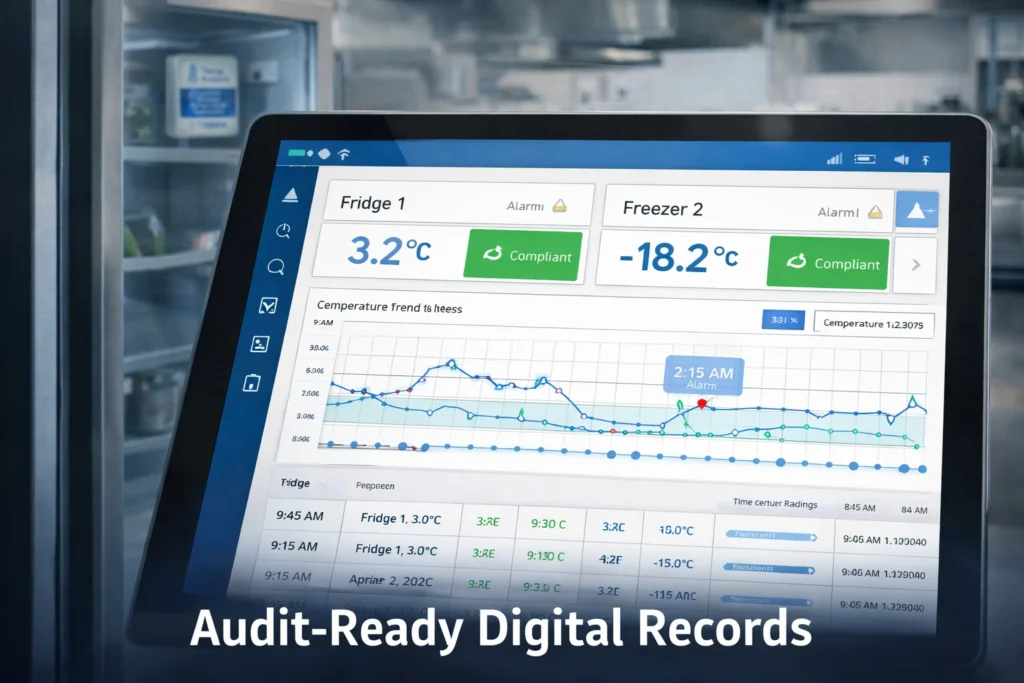
Restaurant temperature compliance in Australia increasingly requires defensible documentation. Digital systems provide time-stamped, tamper-resistant records that can be reviewed instantly.
Continuous Monitoring as the Foundation of Compliance
A restaurant temperature monitoring system provides:
- 24/7 automated data logging
- Instant alerts if temperatures drift
- Historical trend graphs
- Secure cloud storage of records
- Audit-ready reporting
If a cool room rises above safe limits, management can respond immediately — reducing stock loss and compliance risk.
Continuous monitoring is not about paperwork. It is about risk prevention.
Digital Records and Audit Readiness
Food safety authorities do not only check the current temperature. They examine:
- Evidence of monitoring
- Consistency of records
- Corrective actions taken
- Patterns of non-compliance
Digital temperature monitoring provides:
- Time-stamped records
- Automated logs
- Clear visual trend data
- Downloadable compliance reports
This strengthens restaurant temperature compliance in Australia by replacing vulnerable paper systems with verifiable digital documentation.
Beyond Temperature: Strengthening Food Safety Compliance
Temperature is only one component of food safety compliance.
Breaches also commonly involve:
- Inadequate cleaning
- Unhygienic conditions
- Pest risks
- Poor record keeping
A digital food safety system can support compliance by integrating:
- Digital cleaning schedules
- Hygiene verification checklists
- Procedure logging
- Documented corrective actions
When temperature monitoring and daily procedures are recorded digitally, restaurants move from reactive compliance to structured risk management.
Reducing the Risk of Repeat Breaches
Many public food safety reports reference “previous warnings given.”
Repeated breaches significantly increase regulatory scrutiny.
Continuous monitoring helps prevent:
- Overnight freezer failures
- Compressor breakdown unnoticed
- Staff forgetting manual checks
- Inconsistent documentation
Restaurant temperature compliance in Australia becomes stronger when monitoring is automatic, not dependent on human memory.
A Practical Approach for Australian Restaurants
An effective compliance system does not need to be complex or expensive.
Modern restaurant temperature monitoring systems in Australia can:
- Include commercial-grade wireless transmitters
- Require no capital purchase of hardware
- Operate on a fixed subscription basis
- Provide automated alerts and reporting
When implemented properly, they protect:
- Stock
- Reputation
- Compliance standing
- Operational continuity
Conclusion
Restaurant temperature compliance in Australia is enforced, visible and increasingly scrutinised.
Manual logs and occasional checks are no longer sufficient to protect against risk.
Continuous temperature monitoring, supported by digital record keeping and structured procedures, provides a practical and affordable way for restaurants to strengthen compliance, prevent stock loss and reduce the likelihood of repeat breaches.
For restaurants seeking a structured, modern approach to compliance, continuous monitoring is no longer optional — it is foundational.