Wi-Fi vs 4G Temperature Monitoring: is one better than the other?
When you are choosing a wireless temperature monitoring system, one of the key technical decisions is how the data will reach the cloud. Two of the most common options are Wi‑Fi and 4G (cellular). Each has its strengths, costs, and limitations.
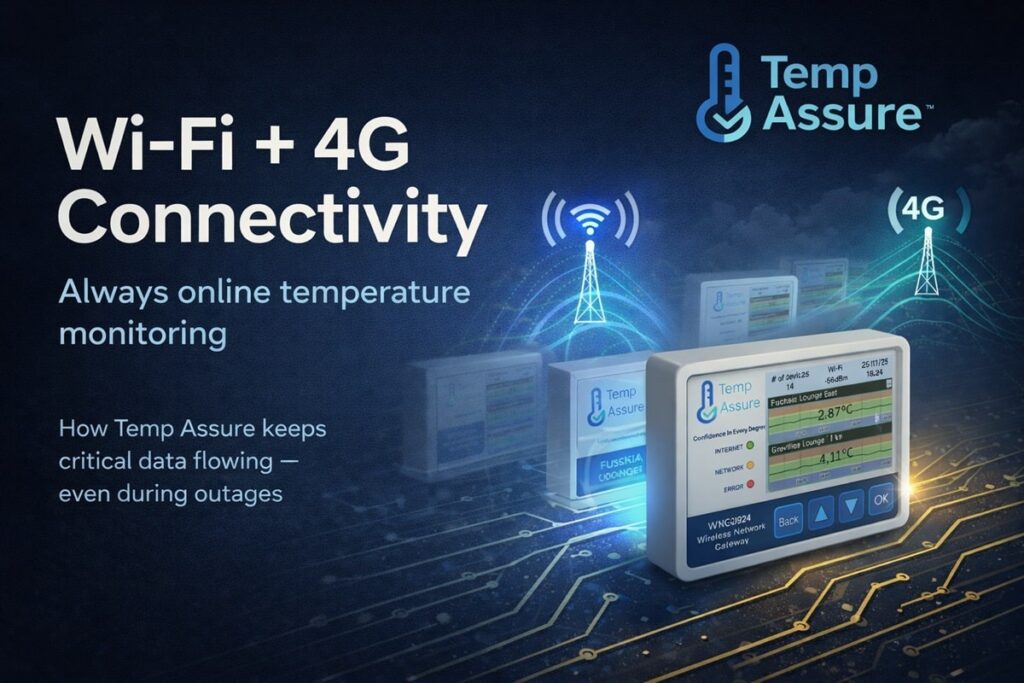
A well-designed system, such as Temp Assure with the WNG0924A gateway, can use both: Wi‑Fi as the primary path and 4G as a backup. To understand why this matters, it helps to look at how each technology behaves in real-world installations.
How Wi‑Fi monitoring works
In a Wi‑Fi-based setup, gateways connect to your existing local network. Temperature transmitters send data to the gateway, and the gateway passes it to the cloud via your internet connection.
Advantages of Wi‑Fi include:
– No ongoing SIM card or data plan costs when using existing internet service
– High data throughput, suitable for many devices
– Easy integration in sites that already have managed Wi‑Fi infrastructure
However, Wi‑Fi is not perfect. It depends on the building’s network design and coverage. In some facilities, Wi‑Fi may not extend reliably into plant rooms, older buildings, or outbuildings. Network changes (such as router replacement or password updates) can also disrupt connectivity if devices are not updated accordingly.
How 4G monitoring works
In a 4G setup, the gateway communicates with the cloud through a mobile network using a SIM card. This reduces reliance on the customer’s network and can be especially useful in locations where Wi‑Fi or wired internet is unavailable or unreliable.
Advantages of 4G include:
- Independence from the site’s local network
- Useful for temporary or mobile installations
- Often more resilient to local IT changes
The trade-off is that 4G requires a data plan and the availability of cellular coverage at the installation site. In some areas, signal quality can vary, and ongoing data costs must be factored into the solution.
The benefits of a Wi‑Fi‑first, 4G‑fallback approach
Rather than choosing Wi-Fi vs 4G Temperature Monitoring in isolation, many organisations gain the best of both by using a hybrid model. The WNG100 gateway, for example, is designed to use Wi‑Fi as the primary connection and switch to 4G if Wi‑Fi is unavailable.
This architecture offers several key benefits:
- Cost efficiency: most data travels over your existing internet connection, minimising 4G usage.
- Resilience: if the local network goes down, the system can still upload critical readings via 4G.
- Flexibility: gateways can be deployed in locations with weak or no Wi‑Fi coverage, relying more heavily on 4G as needed.
Considering the installation environment
The physical environment has a big impact on wireless performance. Thick walls, metal panels, and equipment rooms can all reduce signal strength. Transmitters located inside sheet-metal fridges and freezers are particularly challenging; their signals often need carefully placed gateways and potentially multiple units to form a reliable mesh.
Using gateways that support mesh networking allows sites to extend coverage beyond a single access point. In the Temp Assure ecosystem, gateways can forward data through each other, so only one needs a direct internet connection while others relay readings from more remote areas.
Managing data and alerts in Wi-Fi vs 4G temperature monitong systems
Regardless of whether Wi‑Fi vs 4G, temperatrure monitoring is chosen or both are used, the key requirement is consistent delivery of temperature data to the monitoring portal. Once in the cloud, the system can handle logging, alerting, reporting, and multi-site management in the same way. The choice of connectivity is primarily about reliability and cost, not about what features are possible.
Questions to ask when selecting a system
When evaluating Wi‑Fi vs 4G temperature monitoring, consider:
- How reliable is your existing internet connection?
- Does your Wi‑Fi reach all the areas where fridges, freezers, or rooms are located?
- Are there governance or IT policies that restrict connecting new devices to the network?
- Is 4G coverage strong at your site?
- What is your tolerance for recurring data charges versus relying on your own network?
A flexible system like Temp Assure lets you mix and match according to each site’s needs. The goal is choosing how to implement a temperature monitoring system is not to choose Wi‑Fi vs 4G in isolation, but to design a monitoring solution that remains connected and reliable under real-world conditions.
With the right connectivity strategy, you can focus on what matters most: keeping products safe, maintaining compliance, and having full visibility of your cold chain at all times.