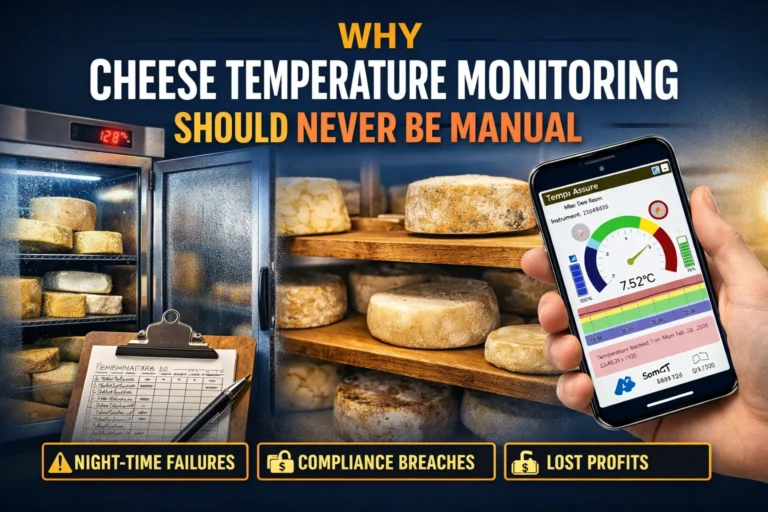
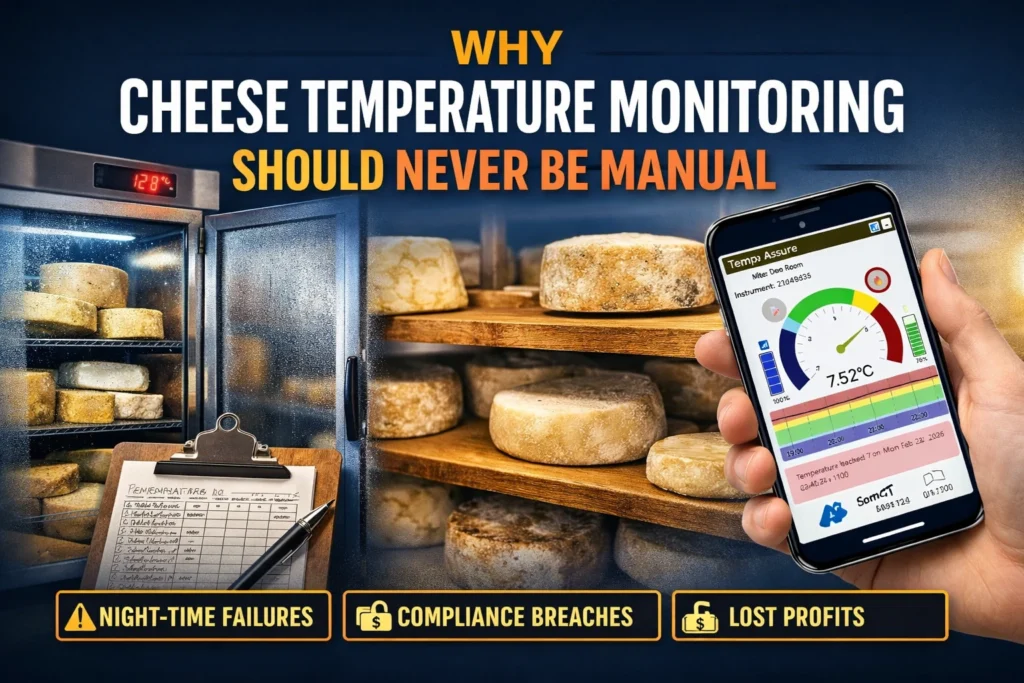
In this article we discuss why cheese temperature monitoring should never be manual
Cheese is not a stable product.
In Australia, food safety standards require potentially hazardous food like cheese to be kept at 5 °C or colder when stored, displayed or transported, and to be checked with a thermometer to ensure it stays within safe limits.
Cheese is biologically active. Its texture, moisture balance and microbial profile depend on stable temperature control. Even small fluctuations — particularly overnight — can accelerate ripening, increase bacterial risk and reduce shelf life.
For artisan producers, specialty retailers and delicatessens, temperature instability affects both quality and margin. Yet many businesses still rely on manual temperature logging to manage this risk.
That approach is no longer sufficient.
The Fundamental Problem With Manual Logs
Most cheese businesses monitor temperature using a simple system:
A thermometer inside the cabinet.
A clipboard.
A once-or-twice daily check.
This creates a dangerous gap.
If a cabinet rises to 9°C at 1:30am due to a compressor fault and returns to 4°C by 6:00am, the morning check will show a compliant reading. The log will appear correct. No breach will be recorded.
But the cheese has already experienced temperature abuse.
Manual logs capture a single moment in time. They do not record what happens between readings. And in temperature management, the unseen hours are where the real risk lies.
Compliance Expectations Continue to Rise
In Australia and New Zealand, cheese businesses operate under the requirements of Food Standards Australia New Zealand (FSANZ) and the Food Standards Code.
Potentially hazardous food must be:
- Maintained at or below 5°C (unless validated otherwise)
- Monitored consistently
- Recorded accurately
- Supported by documented corrective action
During audits, inspectors routinely question:
- Gaps in records
- Identical daily readings
- Perfectly repeated temperatures
- Missing corrective action notes
Manual logs record a moment. Risk occurs between moments.
Cheese Storage Temperature Compliance in Australia
Under Australian food safety legislation, cheese is classified as a potentially hazardous food and must be stored under temperature control to minimise microbial growth.
In practical terms, this means:
Maintaining storage at or below 5°C (unless validated otherwise)
Demonstrating continuous temperature control
Retaining accurate and verifiable records
Providing documented corrective action where deviations occur
Environmental Health Officers and third-party auditors increasingly expect objective evidence of control — not handwritten records alone.
For Australian cheese producers, delicatessens and specialty retailers, compliance is not simply about having a thermometer. It is about being able to demonstrate temperature integrity at any time.
Continuous monitoring provides that evidence.
The Real Risk Happens When No One Is Watching
Temperature incidents rarely occur during staffed hours.
They happen:
- When a display door is not fully closed
- When a compressor cycles incorrectly
- During power interruptions
- When humidity causes evaporator icing
- During overnight equipment stress
Without continuous monitoring, these events go unnoticed until the next shift.
By then, stock value is already at risk — and there is insufficient data to support your decision.. Should the stock be discarded? Discounted? Retained? Without recorded data, there is no defensible answer.
Manual systems provide no early warning.
Manual Monitoring Creates Operational Friction
Beyond compliance exposure, manual systems also:
- Consume staff time
- Depend on individual consistency
- Require physical record storage
- Increase stress during inspections
- Provide no performance trend analysis
They are reactive by nature.
They tell you what the temperature was when someone looked — not when it mattered.
Continuous Monitoring Changes the Equation
Continuous cheese temperature monitoring provides:
- 24/7 automated data logging
- Real-time alerts if temperatures rise
- Secure cloud-stored records
- Instant downloadable compliance reports
- Documented corrective actions
- Trend analysis for performance optimisation
Instead of discovering a problem in the morning, you are alerted when it happens. That shift — from retrospective recording to proactive management — fundamentally changes risk exposure.
It also changes audit confidence.
Start Monitoring Today
Subscription monitoring is available from $22 per asset per month or $60 per asset per quarter
→ Start Monthly Billing $22 per month per monitoring point
→ Start Quarterly Billing (Best Value) $60 per quarter per monitoring point
Continuous Monitoring Without Capital Expenditure
Traditionally, upgrading to automated temperature monitoring meant purchasing hardware outright — creating capital expenditure that many small producers and retailers were reluctant to approve.
Temp Assure’s continuous monitoring system requires no capital expenditure.
There is no upfront hardware purchase.
Monitoring is delivered as a managed compliance service, including equipment, software, data storage and alerts.
This means cheese producers and specialty retailers can:
- Eliminate manual logs
- Improve compliance protection
- Receive real-time alerts
- Access secure cloud records
- Avoid equipment ownership risk
— without diverting capital away from production, stock or growth.
For many operators, removing the capital barrier makes the decision straightforward.
The Financial Impact Is Often Underestimated
A single specialty cheese display cabinet can represent:
- Thousands of dollars in stock
- Weeks or months of maturation
- Significant brand reputation
One overnight failure can erase weeks of margin.
Preventing just one incident often covers the cost of monitoring for years.
In addition, continuous data allows operators to avoid running cabinets colder than necessary. Over-cooling to “be safe” increases energy consumption and can negatively affect product texture. Stable, validated temperature control protects both quality and operating costs.
Start Monitoring Today
Subscription monitoring is available from $22 per asset per month or $60 per asset per quarter
→ Start Monthly Billing $22 per month per monitoring point
→ Start Quarterly Billing (Best Value) $60 per quarter per monitoring point
Temperature Control Is a Governance Responsibility
Outsourcing refrigeration maintenance does not outsource accountability.
Management remains responsible for:
- Food safety
- Storage conditions
- Documentation integrity
- Regulatory compliance
Temperature risk is not operational.
It is governance.
And governance cannot rely on a clipboard.
Conclusion
Manual cheese temperature logging was once considered adequate. Audits were less rigorous. Labour was less costly. Expectations were lower.
That environment no longer exists.
Cheese temperature monitoring should never be manual — because the risk between readings is where the real exposure lies.
Continuous monitoring provides visibility, accountability and protection.
For cheese producers and specialty retailers, it protects product integrity, compliance confidence and financial margin.
Temp Assure Managed Compliance delivers continuous temperature monitoring designed for specialty food environments.
If you produce, age or retail cheese, manual logging is no longer defensible.
It is time to move to continuous, managed compliance — without capital expenditure.
Start Monitoring Today
Subscription monitoring is available from $22 per asset per month or $60 per asset per quarter
→ Start Monthly Billing $22 per month per asset
→ Start Quarterly Billing (Best Value) $60 per quarter per asset
For Further Information here is a list of Related Dairy Product Temperature Guides
| Topic | Quick Jump |
|---|---|
| Ice Cream freezer temperature best practice | https://tempassure.com.au/what-is-the-ideal-ice-cream-freezer-temperature-for-commercial-storage/ |
| Yoghurt storage temperatures in commercial kitchens | https://tempassure.com.au/what-is-the-ideal-yoghurt-storage-temperature-in-commercial-kitchens/ |
| Cheese temperature monitoring tips | https://tempassure.com.au/why-cheese-temperature-monitoring-should-never-be-manual/ |
| Gelato display cabinet temps | https://tempassure.com.au/setting-the-ideal-gelato-display-cabinet-temperature-and-what-happens-if-it-drifts/ |
| Gelato freezer comparison: -22 vs -18 | https://tempassure.com.au/gelato-freezer-temperature-22-vs-18/ |